Inflation Reimagined: The Enemy That Never Retreats
Why rising prices quietly reshape your financial future and what to do about it.

The Threat That Feels Invisible… Until It Isn’t
For long periods, inflation can feel like a non-event.
Prices move slowly.
Cost increases feel manageable.
The impact on everyday life is subtle.
Over time, many people stop thinking about inflation altogether.
But that doesn’t mean it disappears.
It is still there, quietly eroding purchasing power in the background.
And then, eventually, it becomes impossible to ignore.
When Inflation Returns
At times, inflation accelerates quickly.
A combination of factors can come together at once. Economic stimulus, supply constraints, and global uncertainty can all place pressure on prices.
When this happens, the impact becomes immediate and visible.
Everyday expenses increase.
Household budgets tighten.
Financial decisions become more deliberate.
It serves as a sharp reminder of something many people overlook.
Inflation is not just an economic statistic.
It is a direct force on your lifestyle.
The Reality Most Headlines Miss
When inflation rises, central banks often respond by increasing interest rates to slow demand and stabilise prices.
Over time, this can bring inflation back down to more normal levels.
On the surface, this sounds like a resolution.
But there is an important detail that often gets overlooked.
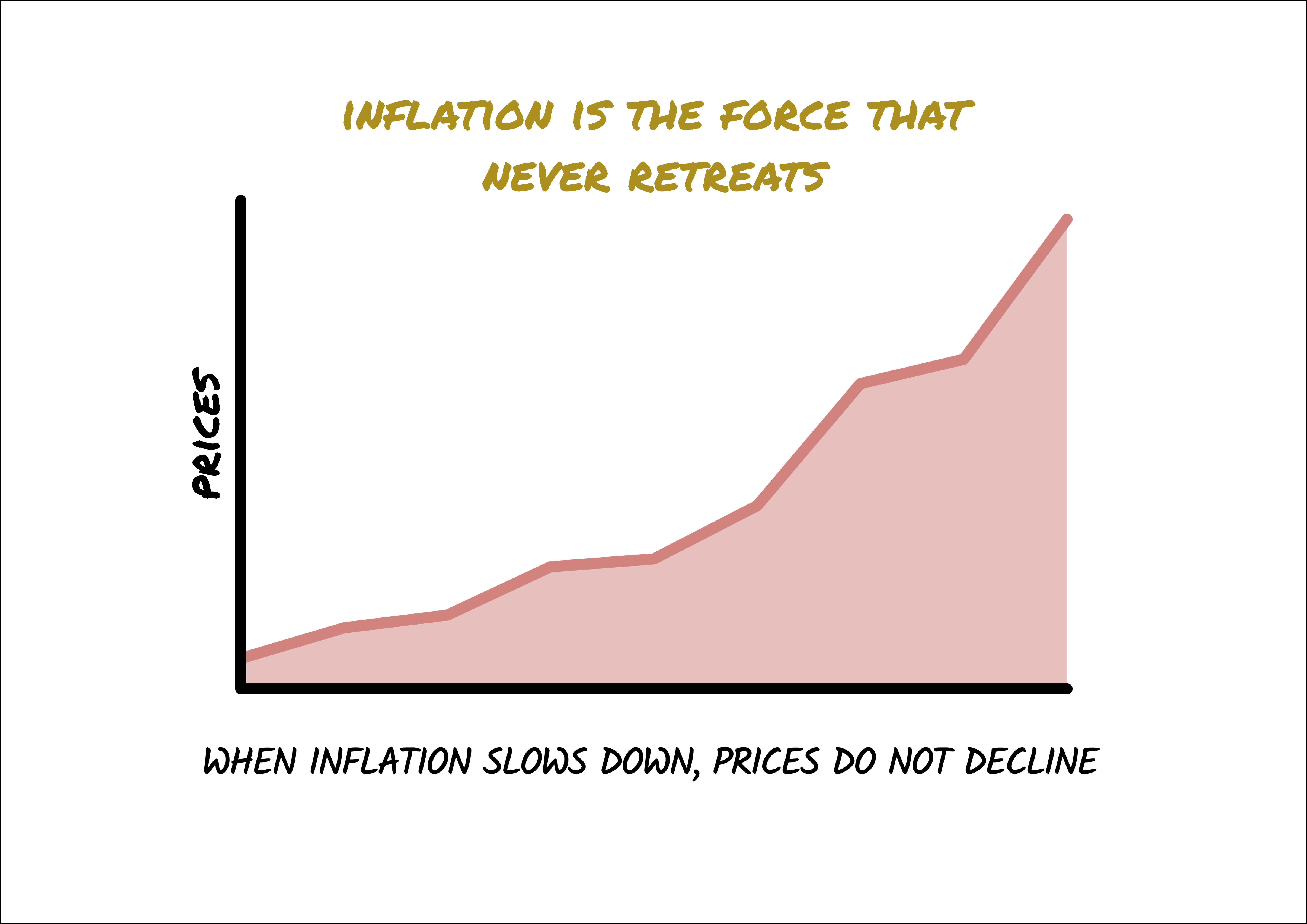
When inflation slows, prices do not fall.
They simply stop rising as quickly.
The higher price levels remain.
This means the cost of living has permanently reset.
Inflation is not just a temporary spike.
It leaves lasting effects.
Why This Changes Everything
Understanding this concept is critical.
Inflation does not need to stay high to cause damage.
Even short periods of elevated inflation can permanently reduce what your money can buy.
This is why we view inflation as one of the most significant long-term risks investors face.
Because over time, it compounds quietly.
And if your money is not keeping up, you are effectively moving backwards.
The Lessons Worth Keeping
Rather than assuming inflation will always remain low, there are a few practical lessons investors can carry forward.
1. Be intentional about spending
Rising costs create clarity.
They encourage better decisions about where money is going and whether it aligns with what truly matters.
Living within your means has always been important. Inflation simply makes that reality more visible.
2. Challenge your assumptions
Financial plans are often built on expectations about the future.
It is important to question whether those assumptions are realistic.
Are you relying on consistently low inflation, or are you prepared for periods where it rises?
Planning for a range of outcomes creates resilience.
3. Own assets that can adapt
Not all investments respond to inflation in the same way.
Some assets remain fixed, while others have the ability to adjust.
Productive businesses, for example, can respond to rising costs by increasing prices, improving efficiency, and continuing to grow.
Over long periods, this ability to adapt has allowed them to outpace inflation and preserve purchasing power.
This is what makes them such an important part of long-term portfolios.
Redefining What Money Really Means
At its core, money is not just a number.
It represents what you can actually do with it.
The lifestyle it can support.
The choices it allows.
The security it provides.
In that sense, the only definition of money that truly matters is purchasing power.
And inflation is the force that constantly works against it.
Winning the Long Game
Inflation is persistent.
It does not retreat. It only changes pace.
But it is not unbeatable.
With the right approach, it can be managed.
Staying invested in assets with the potential to grow over time is one of the most effective ways to protect against it. Pairing that with thoughtful planning and ongoing adjustments creates a strategy built for the long term.
We see our role as helping guide these decisions.
Not just managing investments, but helping you understand the trade-offs, stay focused on what matters, and position your portfolio to navigate whatever comes next.
Because while inflation may always be present,
so is the opportunity to stay ahead of it.
*Main image from HUM